Escaping SaaS Fatigue: Why High-Growth Businesses Are Replacing $50/Seat Subscriptions with Owned Custom Portals
The average company pays for 20+ software tools. Discover why forward-thinking organizations are cutting the seat tax and consolidating into owned custom web applications.
A decade ago, Software-as-a-Service (SaaS) was celebrated as the ultimate democratizer of business technology. Instead of paying upfront for clunky legacy software, businesses could access enterprise tools for a modest monthly fee on a corporate card.
Fast-forward to 2026, and the reality looks very different for scaling enterprises and mid-market organizations across the globe:
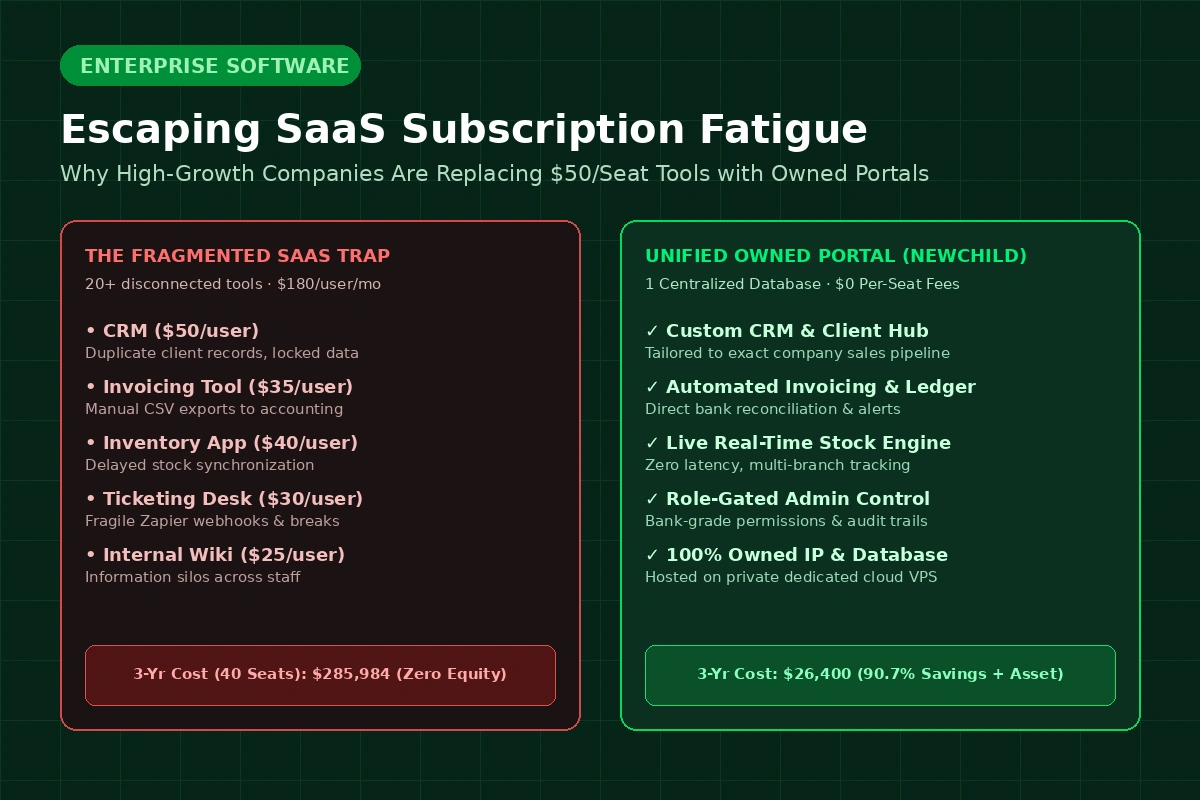
- SaaS Subscription Sprawl: The average growing business now pays for between 18 and 35 distinct software subscriptions across CRM, project tracking, inventory, ticketing, billing, internal wikis, and team communications.
- The "Seat Tax" Growth Penalty: As your company expands from 10 employees to 50 or 100, your software bills scale aggressively. A tool charging $45/user/month silently morphs from a harmless $450/month line item into a $54,000 annual recurring drain—often for software where staff only use 15% of the feature set.
- Unilateral Price Hikes & Vendor Lock-in: Major SaaS platforms routinely bump subscription prices by 15% to 30% year-on-year, knowing full well that extracting your historical customer data and retraining staff is painful and disruptive.
The Hidden Operational Costs of SaaS Fragmentation
Beyond the raw monthly invoices, subscription sprawl introduces operational friction that quietly erodes profit margins and executive focus:
1. The "Zapier Duct-Tape" Fragility
When your CRM lives in Tool A, your inventory in Tool B, your invoices in Tool C, and your support tickets in Tool D, your entire business depends on a fragile web of third-party webhooks, iPaaS connectors, and API middleware. When an external endpoint changes or a webhook fails silently, customer data falls out of sync, leading to duplicate orders, delayed fulfillment, and billing discrepancies.
2. Workflow Mismatch & Context Switching
Off-the-shelf software is engineered to serve millions of generic companies worldwide. As a result, your internal team is forced to bend its unique, competitive operational workflows to fit the rigid constraints of someone else’s software interface. Staff spend hours toggling between 8 browser tabs just to fulfill a single client order.
3. Data Sovereignty & Regulatory Compliance Exposure
Every new SaaS tool added to your business represents another external third-party holding your proprietary client lists, transaction records, and confidential operational intelligence. For regulated industries or businesses handling sensitive commercial data, SaaS sprawl creates an unmanageable surface of compliance vulnerability.
The 3-Year Math: Renting Generic SaaS vs. Owning a Custom Portal
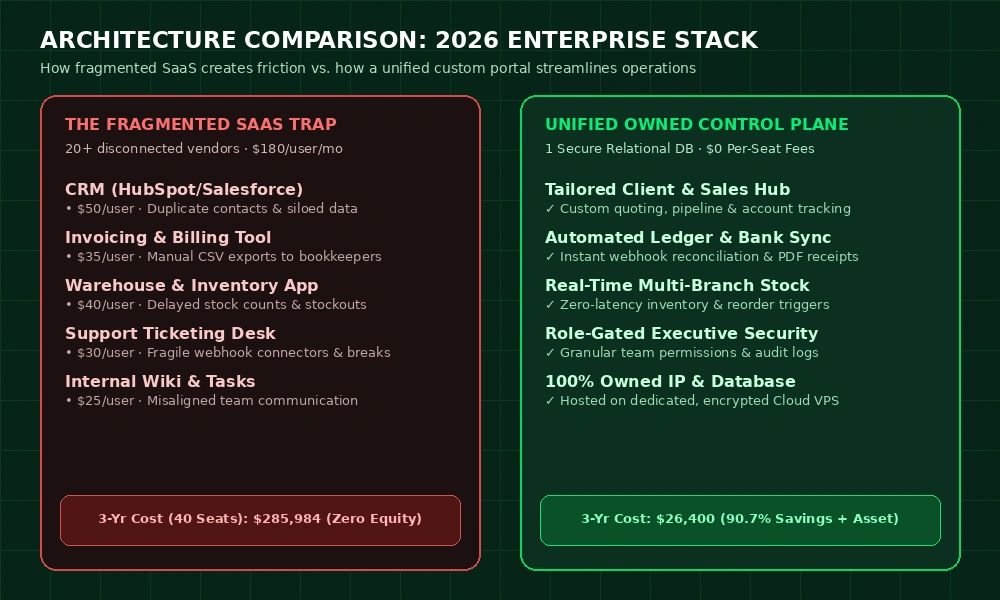
Let us look at the actual Total Cost of Ownership (TCO) for a 40-person operational team over 36 months:
| Expense Category | 5-Tool SaaS Stack ($180/user/mo) | Owned Custom Portal (Laravel 11 + Dedicated Cloud) |
|---|---|---|
| Year 1 Cost | $86,400 (40 seats × $180 × 12 mos) | $18,000 (Bespoke build) + $1,200 (Cloud VPS) = $19,200 |
| Year 2 Cost | $95,040 (Factoring 10% vendor price bump) | $1,200 (Hosting) + $2,400 (Maintenance) = $3,600 |
| Year 3 Cost | $104,544 (Cumulative price hikes) | $1,200 (Hosting) + $2,400 (Maintenance) = $3,600 |
| 3-Year Cumulative Total | $285,984 (100% Operational Sink) | $26,400 (Capital Balance-Sheet Asset) |
| Net 3-Year Enterprise Savings | — | $259,584 (90.7% Cost Reduction) |
The Core Financial Insight: When you rent generic SaaS, your technology spend is 100% operational expense that leaves zero residual equity. When you commission an owned portal, the codebase and unified database become intellectual property and capital balance-sheet assets owned outright by your enterprise.
The Strategic Decision Matrix: What to Rent vs. What to Build
Not every software tool in your business should be custom-engineered. Prudent technology leadership follows a clear architectural boundary:
| RENT OFF-THE-SHELF (Commodity Utilities) | BUILD & OWN (Core Operating Engine) |
|---|---|
|
|
How Modern Engineering Makes Custom Portals Fast, Modular, and Secure
In the past, commissioning custom enterprise software required a 12-month engineering lifecycle and a six-figure budget. Today, modern frameworks have rewritten the delivery timeline:
- Modern Framework Acceleration (Laravel 11 + Filament 3): Enables the rapid delivery of bank-grade, role-gated admin control panels, real-time analytics, and relational database workflows in 2 to 4 weeks instead of months.
- Unified Relational Architecture: All your customer records, invoices, fulfillment stages, and inventory live inside a single, fast, secure relational database with automatic daily snapshots and point-in-time recovery.
- Zero Per-Seat Connector Fees: Need automated WhatsApp dispatch notifications? Direct bank webhook reconciliation? Custom PDF proforma generation? Custom portals integrate directly with your preferred APIs without paying monthly connector penalties.
The 4-Step Playbook for Business Leaders
If your organization is feeling the weight of subscription sprawl, follow this practical 4-step audit:
- Run a 30-Day SaaS Audit: Gather the last 3 months of corporate card statements. List every recurring software charge, the number of paid licenses, and actual active usage. Identify unused "zombie seats" and duplicate tools.
- Isolate the Primary Bottleneck: Identify the single core business workflow causing the most manual spreadsheet copy-pasting across your team (e.g., quote-to-fulfillment or stock dispatch).
- Scope a Unified Control Plane: Specify the exact database fields, permissions, and status workflows your team actually requires—stripping away 80% of the generic bloat found in off-the-shelf software.
- Deploy on Private Infrastructure & Deprecate Subscriptions: Launch the custom portal on a dedicated VPS, migrate historical records cleanly, train your team, and cancel the redundant recurring subscriptions.
Take Control of Your Business Technology with Newchild
At Newchild Information Technologies, we design, engineer, and deploy high-performance, secure, and fully owned web platforms, customer portals, and internal management systems tailored specifically to your company’s operational workflow.
-
✓
Zero Per-Seat Fees: Scale from 5 users to 500 without paying extra software rent.
-
✓
100% Data Sovereignty: Your data, code, and customer records remain under your direct control on private dedicated servers.
-
✓
Enterprise Stability: Built on robust, modern frameworks with automated backups and bank-grade security.